THE RENEGADES
I WAS THERE
An interview with Graham Johnson
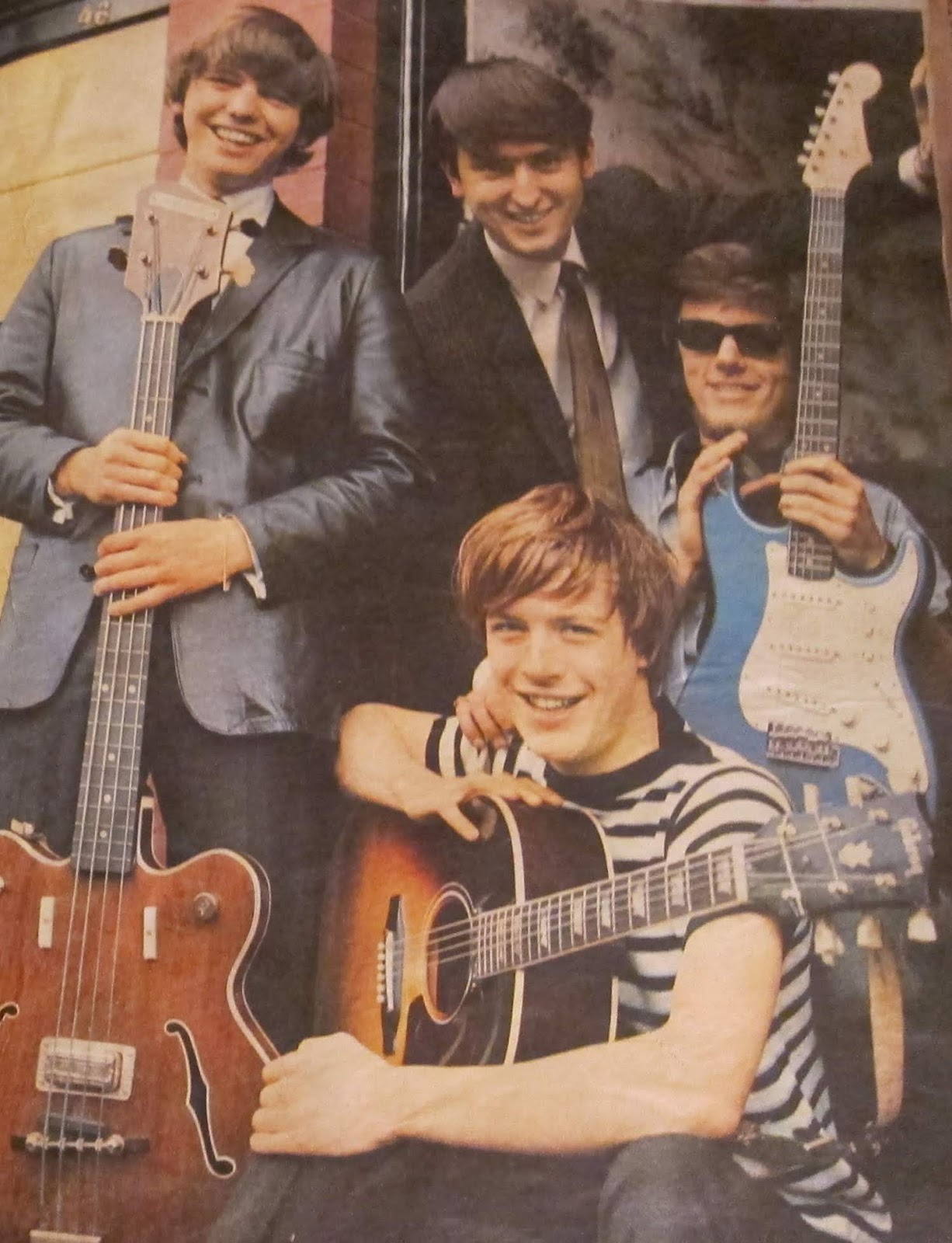
Kim Brown (lead vocals, guitar, harmonica, keyboards), Denys Gibson (lead guitar, vocals), Graham Johnson (drums, vocals), and Ian Mallett (bass guitar, vocals) were all born and bred in Birmingham, England. In the early sixties they formed the Renegades, and a couple of years later conquered first Finland and then Italy with their unique mixture of fifties rock 'n' roll, British rhythm & blues and harmony pop. I've had the honor of getting in touch with Graham Johnson, who kindly shared with us stories of his time in one of the coolest bands touring the Arctic zone.
What was it like growing up in Birmingham?
Kim and Natch (Ian—that's what we called him) lived in Perry Bar. They lived close to each other, within walking distance, and they were childhood friends since they were five. I was born in Erdington (another district of Birmingham) which was approximately six kilometers from Kim's and Natch's houses. Birmingham is the second largest UK city and was a big industrial area. We all grew up in the post-war era. I can remember food rationing being still in force and the anti-air raid barracks nearby where my father was stationed. He didn't go to the front as he was also employed in the factory, manufacturing aircraft and other military vehicles. We used to go and play in the air raid shelters. The guns of course had been dismantled. There were still a few bombsites left. We had a small shelter in the back garden. Erdington was, I suppose, a reasonably quiet area of the city, and my early friends were from my street.
How did the four of you meet?
At 14 my parents moved away from Erdington to a smarter area called Four Oaks, approximately 10 kilometers out of town. I had already moved onto King Edward VI Grammar School, which was in Aston, but I was lucky—you'll see why shortly—that despite the increased traveling distance, I managed to stay on at KEGS. At 14 I moved up into the fifth form (I was one of the youngest in that year). In those days, the exams which we took at the end of the final fifth year were called GCE (General Certificate Of Education) and boys who failed to pass on important subjects could remain on for another year and re-sit the exams they failed. Ian and Kim and myself all went to the same school, but they were a year older than me so we didn't meet up until a stroke of good fortune. Kim left school after ending his fifth form, but Ian stayed on to re-sit certain subjects again
When was the idea of starting a group born?
One day we were in the Physics lab for a lecture, after which I left my wallet behind on the desk. Ian picked it up, and inside there was a photo of me behind the drums. When he returned my wallet he excitingly said, "I saw the photo of you on the drums, would you like to join a group we are forming?" Of course, I said yes because up until then I had been playing alone, which is no fun for drummers. The following weekend, my father drove me over to Ian's house with the drum kit, where I met Kim. At school, because of the year difference, we had never met each other. There were 600 boys in the school.
So that was the beginning. A friend of Kim and Ian worked with a guy who was a guitarist, Denys, and brought him over to rehearsals. That was it. Kim and Ian chose the name from a dictionary and the Renegades were born. We used to rehearse in Kim's parent's front room. There was an upright piano and Kim used to do a Jerry Lee on it.


When did you start playing the drums?
My earliest recollection of becoming involved in music was being invited to a friend's house to play Buddy Holly's “Peggy Sue.” I was literally at the beginning and wasn't really able to follow Jerry Allison's drum riff, which is a fundamental part of that song.
When I started at junior school, I made friends with a new boy, John, who lived a little farther away, maybe two kilometers, and we became very close friends. I was always round at his house. I used to bike over. We got up to many things. One in particular was making Super 8mm home horror movies such as Dr Jekyll and Mr Hyde, Frankenstein etc. Unfortunately he died young in a car crash in Germany and I never managed to trace those films. It would be fantastic to find them. I heard his brother had them, but with me living on the continent with the Renegades I lost contact.
Ever since I was quite young I always had a feeling for the drums. I had an elder cousin who was also a drummer, I was just a baby then, but I remember seeing his kit and my eyes sparkled. At home there was an old drum kit of one of my father's friends lying in the loft so one day I got the OK to bring them down. I repainted them light blue with GJ on the bass drum and we formed a skiffle group with my friend John on tea-chest bass and another friend, Clive, on guitar. We used to play "Move It," and I thought it was great, especially when the drums came in after the intro. I was thirteen.

As a drummer, any early role models?
To start Tony Meehan (the Shadows) and Dave Mountney, drummer of the Beachcombers, a Birmingham top group. I was just starting, and together with Tony I suppose I copied their styles. The Beachcombers were the resident group at a top Birmingham venue called The Plaza where we used to play in Brum. The owner, Mrs Reagan, used to book the groups, and it was considered an honor to play her clubs. She owned another called The Ritz. She had a Welsh accent and used to say, "I'll pay you well, five pounds." We continued to laugh about that all through the years with the group.
The Beachcombers' lead singer Pete Green later went solo as Peter Lee Sterling but really made it as Daniel Boone with the two million [selling] hit "Beautiful Sunday." I also liked Frank Farley, drummer with Johnny Kidd & the Pirates. Nice and solid, no messiness. I loved his break in "Shakin' All Over." Then, of course, the iconic Ginger Baker. Ginger's style was revolutionary. I just had to learn that bass drum.
Where your parents involved in music?
Kim's father used to play banjo. My father studied violin as a youngster, but I never heard him play. He moved on to banjo-ukulele (half banjo and half uke) and upright piano, which like Kim's house stood in the front room. He used to entertain us all at parties and he was a favorite at his local pub singing all the famous British wartime songs.
As mentioned before I started on the drum kit found in the loft, then my mother bought me mixed set of Premier/Ajax and Olympic which I used on our early gigs. Later when the Renegades started to work I changed to Rogers. I loved that kit and I still have the snare drum I used for the intro of "Cadillac."
There's a long tradition of rock 'n' roll in Birmingham. Many known, and less known, names started their career there in the late fifties and early sixties. Steve Gibbons & the Dominettes, Denny Laine (Moody Blues, Wings) & the Diplomats, Mike Pinder (Moody Blues) was in the Rocking Tuxedoes, Christine Perfect (Fleetwood Mac) was part of an early Rockin' Berries lineup, the Detours had Jimmy Powell on vocal. Beverley "Bev" Bevan (Move, ELO) was behind the drums in Ronnie & the Senators; both the Falcons and Mike Sheridan & the Nightriders included Roy Wood (Move, ELO, Wizzard); Carl Wayne (Move) & the Vikings. The R&B Quartet became Spencer Davis Group, Trevor Burton (Move) & the Everglades, John Shakespeare and Ken Hawker called themselves John Carter and Ken Lewis and became first Carter Lewis & the Southerners and later the Ivy League.

Birmingham must have been a melting pot of rock 'n' roll and pop music and you were in the middle of it all. Must have been a great time! How did that influence you?
Yes it certainly was. We knew and played with many of the names/groups you have mentioned. Before we went to Finland, we were quite popular in the Midlands and had our own fan club already. Originally we had our own individual musical tastes. Kim and Ian were rock 'n' roll fans—Jerry Lee, Fats, Little Richard, Gene Vincent, etc. Kim was also a big fan of Joe Brown. Denys and I were big Cliff and the Shadows fans. Denys later became a keen blues follower. I liked trad jazz—Chris Barber, Humphrey Littleton and Kenny Ball—but basically I guess we were rockers.
Like many groups at the time we also jumped on the blues bandwagon, playing songs by Howlin' Wolf, John Lee Hooker and Muddy Waters. Kim would play harmonica; it was cool. In those early days, we used to play at an all night coffee bar in Manchester called The Twisted Wheel. They used to have guest artists appear and one time we played with the Graham Bond Organisation (Graham Bond, Dick Heckstall-Smith, Jack Bruce and Ginger Baker).
On several occasions Spencer Davis, who was then an unknown school teacher, used to travel up to Manchester with us in our van and play his sessions during our break. He was a great guy. We also opened with Spencer the first Birmingham Blues Club at the Golden Eagle Pub in the town center.
Can you remember the first gig the Renegades did?
Our first gig in front of a live audience was on 31st January, 1962 in Birmingham at Aston Lane Youth Club. I remember the kids liked us and it was a great feeling. We then moved on to play at all the famous Birmingham clubs/pubs/venues and also other cities including Manchester, Nottingham, Burton.


Your first recordings were the six demos you recorded at Hollick & Taylor studio in 1963. One of them was included on the Brum Beat album. It's an instrumental number called "Hungarian Mod," was it typical of how the early Renegades sounded?
Well, not really. We were basically rock 'n' rollers. The idea to do "Hungarian Mod," our adaptation of Liszt's Hungarian Rhapsody, was to highlight Denys's guitar skills. In those early days, he was a much better musician than the rest of us, and most of the guitarists who were around. When we performed it onstage, the three guitarists used to turn their backs to the audience and play with the guitars behind their heads. We came third in a group contest held at the Locarno Ballroom in Birmingham city center. There were many of the groups you mentioned earlier also taking part. It was a gimmick and went down well but it wasn't really our style.


The next year you recorded two songs for OAK Records, "Bye Bye Johnny" and "She Lied." The first one is of course the Chuck Berry song, but the other one was that one of your own songs? Both are still unreleased.
You know, Per, I really don't remember recording these two tracks. Do you know where I can listen to them? Is it really us? , I've been asked this before and gave the same answer.
I've been in contact with the guy that has got the only known acetate of the two songs recorded for OAK Records. Unfortunately he won't let us hear them. Sorry Graham.
I don't believe the Birmingham Renegades recorded these tracks, and as the guy who has this demo won't allow me to verify this I would exclude this.
Can you tell me about the album you made as the Mersey Sound, released by Fidelio Records in 1964?
The Brum Beat album was released on a London label called Dial. The Managing Director David Gooch was in charge of everything, and I think he liked the Renegades in particular. The groups from Liverpool were becoming big business, above all the Beatles. Everyone waited anxiously for their next release so they could to rush out and buy it. Somehow David had gotten hold of a demo of their next single which I believe was "She Loves You," and I think "You Can't Do That." He rushed us into Hollick & Taylor studio. His idea was to release our version before the Fab Four. Of course there was no way we could possibly compete with the Beatles' versions and they never got released. We also recorded other songs that were popular at the time. I have no idea who was responsible for putting those tracks out. They were terrible.

When did the Renegades become professional?
I think it must have been end 1962 or early 1963. By the time we went to Finland in September '64 we had been professional for some time.
Many British groups went to Hamburg, Germany, but the Renegades headed for the cold Finland. How come?
We auditioned to go to Germany but never got chosen. We had lots of work in the Midlands so we didn't really care, although later we did a small tour later. Anyway Finland. Keith Mallett, Natch's brother, who was social secretary at Manchester University (a job later taken over by Chris Wright founder of Chrysalis Records) went over to Finland as a teacher, that must have been early 1964. Whilst in Helsinki he met a Finnish agent, Leo Heinonen of Finnshow, who reluctantly agreed to book us for a two-week tour starting in October. We stayed for two months!
Before you went to Finland what did your repertoire look like?
Lots of rock 'n' roll, Chuck, Little Richard, Jerry Lee, “Thirteen Women,” “Tallahassee Lassie,” some R'n'B/Blues. Of course “Cadillac” (the hit version, ours), “Seven Daffodils,” “White, Brown & Black.”
Tell me about your pre-Finland shows.
In the early pre-Finland days, we always tried to add some showmanship to our stage act like jumping in the solo of "Seven Daffodils," and playing the guitars behind our heads in "Hungarian Mod." There was usually some comic gimmick in the songs we played on stage.


You also did a spectacular Jack the Ripper performance.
At that time, Screaming Lord Sutch was around doing his Jack the Ripper stage show. We liked his idea so we decided to include it in our stage act. The Ripper show took place after the mid-show break as we needed to prepare the stage for the act. We asked the club owners to dim the lights so we could bring in a coffin, which we had made in Ian's garden summer house. This was placed centre stage. Before starting, we lit some large candles and the atmosphere was quite macabre. Ian had changed into the clothes of the Ripper's first victim, Mary Kelly. Denys and I started off the "Ripper" intro with the lights still low. Then suddenly Kim, fully dressed in Ripper black cloak and top hat, sprung from the back of the club waving a 12-inch kitchen knife at the girls as he headed for the stage. The effect was, to say the least, quite frightening, screams all round. The guys loved it.
Kim, upon reaching the stage, started to go through the song, waving the knife and all. At the end, the young damsel, Ian, raised her (his) hand to request going to the loo, as we used to do at school. Kim gave him the ok and he (she) headed for the corner of the stage with a chamber pot in hand. After he had apparently finished, he walked to the centre of the stage and proceeded the throw the contents over the audience. Everyone tried to steer clear, but to their surprise the pot was full of rice. However, the required effect was made. I can vaguely remember the Ripper set ended with Ian doing a comic striptease.
OK, we pinched the idea from Dave Sutch, but our version was always a big success with the public.

Did you bring the Ripper act to Finland as well?
With the advent of our success in Finland, we dropped the Ripper act, keeping only some of our comedy stunts, although the Ripper stage gear remained on the roof rack of the van for ages (it can be seen in various photos) until the Finnish winter took care of it.
Whose idea was it to use the American cavalry uniforms? Did you wear them before you went to Finland?
The idea was Kim's and Ian's. I believe The Renegades referred to the North American soldiers that changed sides in the Civil War. Yes, we changed from our original insignificant purple jackets and grey trousers within a year of forming the group. On the Brum Beat photo we already wore them.

We arrived in Turku, Finland by ferry from Stockholm in the last days of September 1964. Our first gig was in Helsinki at Stockman, Helsinki's largest department store. I think it was October 4th. We were treated OK by our Finnish agent. He had never seen us on stage and didn't know how wild our stage act was. We had no expectations; we certainly didn't expect the reaction from the Finnish public.
How long did you plan to stay and how long did you stay the first time you went there?
I believe the original contract was for a 15-day tour but after the amazing success we received it was extended and we finally ended up staying for two months.
We played in various venues. Open air summer dance hall, many sports stadiums of various sizes and some smaller clubs. It varied from place to place.
Some other international artists also went to Finland, like for example Joey Dee, Jimmy Justice, Cliff & the Shadows and, beside the Shamrocks, Swedish groups like Lenne & the Lee Kings, Jerry Williams & the Violents and Jan Rodhe & the Wild Ones.
As far as I can remember, in Finland we met the Shamrocks and became close friends, also Jan Rodhe. I remember playing with the Shanes and the Defenders. Cliff we met later in Italy and Tony Meehan produced an album for Kim & the Cadillacs in the ‘80s.

How many times did you tour Sweden?
I really don't remember but not many. Two, maybe three; too long ago.
"Cadillac" was released in late 1964. It reached number 2 on the Finnish singles chart. Was it an instant hit?
Due to the success of “Cadillac” in our stage shows, Scandia approached us to record “Cadillac” and our first album. It was an instant hit. It should have gone number 1, but I suppose we were a new group.
Your version of "Cadillac" also became a success in Germany, Austria and Switzerland. Did you tour these countries as well?
Yes, also Benelux. We were badly managed tour-wise and record-wise. Ours was the original hit and, had we had proper management and support from the record company, our "Cadillac" would have been a monster European hit. We did a mini-tour in Germany. We had signed a two-month contract for a small club in Munich during the same period when "Cadillac" was number 2. The club owner sold us out for a national tour, making himself a nice profit. We did some gigs in Switzerland, but the venues were not right for our music. Again, badly managed. I don't remember playing Austria. In Benelux we did some TV.
In Sweden, "Cadillac" will always be associated with the Hep Stars, even though Polar Records released your version. Were you aware of their success with your song?
Oh yes, we were very aware of the Hep Stars, and were not very happy. It was all a question of bad organization. We were too young, and Scandia and our Finnish manager didn't have the know-how to handle the situation. I believe we lost our chance to become a major European act because of this. After The Renegades I worked for many years in the music business and saw the enormous errors that were made.

"Cadillac" was actually a rework of "Brand New Cadillac" recorded by Vince Taylor in 1959. You transformed it into a suggestive beat/rhythm & blues number.
Well Vince Taylor's publisher, who was a heavy at the time, won the lawsuit against the small Scandia Music and we split the publishing in certain territories. I heard Vince Taylor's version, that's in a minor key, many years later. In reality, it's completely different. Recently I played with a local rockabilly band and they wanted to do "Cadillac." I was playing one thing (our version) and they another (Taylor's version). Total chaos. Vince won the case due to the similarity of the "Cadillac" lyric, but our version with the loud and quiet gimmick was totally different.
Was that the way you sounded on stage?
Yes "Cadillac" was how we sounded on stage but the record didn't really represent the dynamic live version. There's a live video on YouTube which is pretty accurate.
Yes "Cadillac" was how we sounded on stage but the record didn't really represent the dynamic live version. There's a live video on YouTube which is pretty accurate.
Was it your or Scandia Records idea to exclude Taylor as the composer or at least being part of the composition.
As I said, we had never heard the Vince Taylor version until much, much later. It wasn't a copy, just a coincidence. After the lawsuit we had to include Taylor's name. I believe without our version it would have remained quietly together with the many songs of that period until the Clash covered it many, many years later.
Did you ever meet Vince Taylor? If so, what was his reaction?
Nope! But he should have been grateful to us for making “his” song a hit.
Did you live permanently in Helsinki, Finland?
No we didn't live permanently in Helsinki, although we were there quite often during the sixties. We were also in Italy quite often after Sanremo (1966), and in 1969 it became our permanent base.
The B-side of "Cadillac," "Bad Bad Baby," is an optimal rhythm & blues / pub rock number, which resembles of the Johnny Kidd & the Pirates' recording of “Dr Feelgood,” which was originally a Piano Red song. What were your main influences, the American ‘50s rock 'n' roll artists or their English followers like Johnny Kidd, Vince Taylor, Cliff Richards and so on?
The American rock 'n' roll singers were our main influence. Artists like Jerry Lee, Little Richard, the Everlys and Buddy Holly. We liked Johnny Kidd and especially the Pirates. I think we did a gig with them in England. Denys and I were early Cliff & the Shadows fans. Kim liked Joe Brown. Natch stuck to the Americans.


Cadillac was your first album as the Renegades, released 1964 in Finland. Scandia Records must have rushed out the album. You must have been in the studio rather frequently during your first time in Finland?
Yes, Cadillac was our first album as the Renegades. I really can't remember how long we spent in the studio, but I think it was rather short. We were gigging almost every day.
As early as 1964 you had already made two albums, first under the pseudonym of the Mersey Sound and then the Cadillac album. What was the difference between recording in England compared to Finland?
As I mentioned before the Mersey Sound album was made up of cover versions we did for Dial Records in the very early years of the group’s existence. We recorded it in a small studio in Birmingham with no experience of recording techniques, like most of the groups in those days. Cadillac was a little later, but we were still quite raw and most of the tracks were recorded in one or two takes. We recorded on a two-track machine and had to mix them down for the vocal track. Very simple.


You became good friends with the Swedish group the Shamrocks (see their story in Ugly Things #47). Tell me about your relationship. I understand you got to know each other really well.
Yes we met the Shamrocks in Finland; I think it was already during our first 1964 tour. We did many gigs together and there was an instant friendship between us. In those days there were many parties and we had lots of fun. I think it was the Shamrocks that arranged for our gig in the Munich club, the PN Hit House in Schwabing. They even visited us in Birmingham on one of the few occasions when we were back. When we moved to Italy we lost touch.
One of the songs on the Cadillac album was "If I Had Someone to Dream Of," written by Jimmy Lindskog, who played guitar in the Shamrocks. That was the first of a total of six Lindskog songs you recorded (the others were "And I Need You," "I Was There," "That Song Really Knocks Me," "You're Gonna Lose Her Lovin’," and "Big Star"). You must have felt confidence in his songwriting.
Kim was a big fan of Jimmy's songwriting, and they were nice songs. We were short of material being so much on the road so we decided to record them rather than repeating cover versions of the American stars.
You were backing a Finnish female singer on your second single release, Ann Christine & the Renegades. Both songs, "Comin' Home Baby" and "Right Now," were jazzy numbers earlier recorded by Mel Torme. Tell me about Ann Christine. Why did they bring the two of you together?
I think it was the idea of Scandia to join us together. Ann Christine was very popular at the time and I suppose they thought it was a good idea to sell more records. She was nice and we became friends. I can't recall ever doing a tour together. There were some TV shows.

On the third Renegades single you made a beautiful rework of the folk tune "Seven Daffodils." The B-side, "Do The Shake," was another great rhythm & blues number. The single was taken from the Cadillac album and must have been released just a couple of months after the "Cadillac" single and reached number 12 on the Finnish single chart. I guess you must have been successful from the very beginning?

On the third Renegades single you made a beautiful rework of the folk tune "Seven Daffodils." The B-side, "Do The Shake," was another great rhythm & blues number. The single was taken from the Cadillac album and must have been released just a couple of months after the "Cadillac" single and reached number 12 on the Finnish single chart. I guess you must have been successful from the very beginning?
The release schedules were organized by Scandia. "Seven Daffodils" was part of our stage act from the days in Birmingham and was always a success. "Do the Shake" was put together in the studio in true Renegades sarco-rock style. Strangely it was also one of our requested stage favorites.
It must have been hectic times for the group. Did that in some way affect the friendship within the group?
Oh, it was hectic alright, but despite this there were never really any big arguments between us. We split with Denys in 1966, but that was due his choice to remain with his wife-to-be. Kim, Natch and myself remained close friends right through until their sad untimely deaths.
The Cadillac album is a mix of pop in the Buddy Holly and Everly Brothers tradition and rhythm & blues the way your contemporary English groups interpreted the music by the fifties black rock 'n' roll artists. Do you feel comfortable with that description?
Very generally speaking I would agree but each act had its own style, which I suppose made British groups so special.


When was your second album, The Renegades (Scandia, 1965) recorded? Again it's half your own songs and half covers. There's one particularly interesting cover, the Big Bill Broonzy song "White, Brown and Black," which is about racism. Was rude and bad behavior things you had to live with, not because of the color of your skin, but being a young rock 'n' roll band with long hair?
I suppose it was recorded in 1965. Kim discovered the Broonzy song and as I said before we did it on stage. I can't remember anything really bad happening because of our appearance apart from funny looks, except for one time in Munich, Germany. We were playing a two-month gig in a club in Schwabing, the PN Hit House. We used to go the famous Hofbrauhaus where Hitler started off. We liked the booze, big one-liter stone jugs, and on one occasion me and Kim got physically thrown out of the men's loo by a gang of giant Bavarians. At that time, we couldn't understand what they were shouting, but they were pulling on our hair so maybe that was it.
I really do like the rock 'n' roll covers you recorded, your versions of "Unchain My Heart," "Casting My Spell," "I’m A Hog For You" and "Tallahassee Lassie" are all great, but even greater are the songs written within the group. "You Love Me Too," "My Heart Must Do the Crying," "More Than Peggy Sue," "Don't Make A Fool Out Of Me" and the beautiful "Matelot" are lovely tunes, with great melodies and harmonies. Was this when you started to develop your ability to write you own songs? Or were they already written before you went to Finland?
Thanks, I'm glad you like our own songs. In those early days, we were gigging around the Midlands, and when we were not playing we all had girlfriends, so most of our free time was dedicated to them. On the rare occasions we practiced in Aston Lane church hall, we spent the minimum time going through those songs you mentioned; then the rest was either down the pub or eating cakes and such from a nearby shop. I suppose we weren't very professional, but onstage I believe our show was good. Once we began touring, being together for long periods we began composing in hotels or in the van.


You are all listed as songwriters of every song written by the group. Were you all involved in every composition or was it a gesture of friendship?
We were very close as a band. Something rare, I would say, so we all signed the songs. Many of the arrangements, where everybody put in his ideas, were fundamental for the end result of those recordings. Kim was the main songwriter; he and I wrote quite a few together. I did my share "Bad Bad Baby", "Tell Me If It’s Over," etc.
Who's playing the organ on "Unchain My heart" and "You Love Me Too" and the piano on "Tallahassee Lassie"?
The Finnish studio musician Esko Linnavalli. Scandia presented him to us, he is a well-known musician.
Kim Brown was your lead singer, but was he the only one taking the lead? Listening to the harmonies there were obviously more than just one good singer in the group.
Yes Kim was the lead singer, but we all joined in on many tracks. Denys sang lead on "Too Many Heartaches," the golden voice of Graham Johnson can be suffered in "Walking Down the Street," "Toys," "Hey Look Over Here," and, in Italian, "Il più grande amico per me."


Both "Matelot" (b/w "You Love Me Too") and "White, Brown And Black (b/w “Unchain My Heart") were released as singles in Finland, but only "Matelot" made it into the Finnish single chart, at number 18. Was that a disappointment as the band was such a success on the stage?
Scandia took care of the releases. I think they maybe released too many singles to generate sales. I don't remember anybody being disappointed. We were too busy having a good time. Like I said, not very professional. Later, for bands, it was a completely different story.
Any live performances back home in Birmingham between the visits in Finland?
Yes, we did continue to do gigs in UK, but I can't say much about that. There's a photo of our van parked outside a club with a large queue outside. We were already known in our area. I can remember doing a gig at Birmingham University with Joe Dunnet with our brand new custom-made 100-watt Marshalls, and my beautiful Slingerland drum kit. After we moved to Italy I can't recall doing anymore gigs in UK.


After the 1965 Christmas break home in Birmingham you went back to Finland and at the beginning of February you played together with the Swedish group the Shanes. Their talented lead guitarist Staffan Berggren was still in the group. Can you remember this occasion? It is said that the Shanes was offered, but declined, "Cadillac."
I can remember playing with the Shanes at a club in Helsinki called Natsa. We had long hair, but theirs was even longer.
Your third album was released in the end of August. That makes three albums within less than a year. How was that possible?
I can't really answer that. We must have spent a lot of time in the studios when not on tour.
Your third album is more elaborate than the two before. It's a high class beat record containing many nice ballads. After the first song, the great "Far From It," most of the songs are moody and sensitive, like for example "If It Gets Lonesome," "The World Is My Home," "Don't Run To Me," "A Long Time Ago," and "Things Will Turn Out Right Tomorrow," all written within the group. Also the album included the folk/country tune "The Alamo," and, not to be forgotten, the two songs written by Jimmy Lindskog, "And I Need You" and "I Was There"—which is maybe the best beat ballad ever written. You must have been very pleased with the result.
For the time, we were pleased with all our albums. I think Jimmy's "I Was There" was one of our most ahead of the times recordings. Probably that is why it was released in the States on Norton Records as a single at a much later date.


I read somewhere that in the middle of the sixties the audience was not allowed to dance at concerts in Finland. There had to be a special permit. Because of that it often used to be more like a riot during your concerts. Is that correct?
Riots? Well the kids used to scream at us and sometimes jump on stage. The police were quite strict, but “riots” is a pretty strong word. It was written that “The Renegades were the biggest thing to hit Finland since Adolf Hitler.” I’ll leave the rest to your imagination.
Some of your most devoted fans from Finland even made pilgrimage to Birmingham?
Yes they did. I remember some of "The Roses" (our most faithful fans) went to Kim's parent's house and some visited my parents too.
"Cadillac" became a hit in Germany and you went there for a tour in late 1965. Among other places you played with the Kinks at the Circus Krohne in Munich. Was that when you met Sherman "The German" Heinig.
We met Sherman whilst we we're playing at the PN club in Munich. Although he is of full Germanic origin we were struck by his perfect Liverpool accent, which he'd picked up from one of the British groups, the Escorts. We quickly became friends, and as we needed someone to organize our gear we offered him the job of roadie, which he readily accepted. He stayed with us until Joe Dunnett arrived. He and I are still close friends.


While being in Germany you also tried to go to Venice but got lost by a snowstorm in the Brenner Pass. Was it a serious accident?
Fortunately not, but could have been. Our van was old and not fit for mountain roads in winter. We reached the summit of the Brenner Pass but on the way down due to the bald tires we began to skid on the icy roads, and the van began to slip closer and closer to the sheer drop. The brakes couldn't stop us. Kim and Ian had the doors open, and Sherman and I had opened the back doors too, ready to jump out. Luckily in front of us there was a snow plough that had made a small wall of snow that was enough to prevent the Van falling into the chasm. It stopped us only ten centimeters from the edge. It was a narrow escape.
There is something I have to add about that Italian trip. As I have mentioned, our Ford Thames van was quite—very—old, and we expected some bad weather crossing the Alps so we decided to buy two new tires. We gave Sherman 100 deutschmarks and sent him off to get them. He returned some hours later saying he hadn't found the tires, but he had bought something for the journey. Salty and dry biscuits, cakes and other snacks that were not exactly adapted for such a journey. I don't remember anything to drink, but I do remember there was no change from the 100 marks. He was a young lad, and food was high on his priority list. We had to laugh, and couldn't be angry with him. In the end he turned out to be a shrewd entertainment industry businessman dealing with many top stars still to this day.
How did you get chosen to participate in the Sanremo festival in 1966? Together with the Yardbirds and PJ Proby the Renegades were eliminated by the jury.
In 1965 "Cadillac" was a big success all across Europe. Ariston Records, an independent Italian record company, was looking for an international personality to perform one of their songs on the Sanremo Song Festival, taking place in January the following year. The Sanremo Festival was a song festival, not artists, and each song that participated was performed by both an Italian and an international star. It was the first year that groups with long hair appeared at Sanremo, and it was quite a shock for the audience, who were mostly dressed in elegant evening wear. Our Italian partners were Equipe 84, quite famous at the time. The song "Un giorno tu mi cercherai" (One day you will look for me) was originally in 3/4 tempo, we rocked it up into 4/4 in the middle eight.
After the festival, the RAI, the Italian BBC, at that time had a program where the artists that had been on the show performed their song again live on the air. Denys had acquired, I can't remember where, a starting pistol that fired blanks. We decided to liven up our song a little as it wasn't really our usual rock 'n' roll style. In the middle of what should have been the instrumental solo, we blasted into the solo of "Cadillac," which was one of the highlights of our stage show, where Kim faked a fight onstage with Denys and Ian realistically rolling on the floor. During this, Denys extracted his pistol and proceeded to empty his blank shots at Kim. The festival organizer Gianni Ravera, in fact everyone there, thought it was for real so they freaked out! Of course when the solo finished Kim stood up—he had faked being shot at—and the song continued as if nothing had happened. I would love to have that video. When we came off the studio floor the organizer berated us in Italian—we didn't understand a word at the time—saying that we would never appear on Italian television again. Fortunately he didn't keep his word, and we did many other shows.
Was that when you started to be successful in Italy?
Yes. Sanremo was such a powerful launching pad that whoever appeared became a star overnight. And so it was.

Tell me about the recording of "Thirteen Women," a desirable single among collectors of freakbeat. There's a video made for the song, or was it part of a film? I guess it was a hit in Italy.
It was one of our preferred songs onstage so naturally we decided to record our version of it. I think Denys must have been one of the first guitarists to use a distortion box. Kim told me to thrash the drums as hard as I could while he was screeching out the song. He nearly lost his voice after only a couple of takes—something very similar to John Lennon recordingt "Twist & Shout” that all lead singers must have experienced. The video was for YLE, Finnish state TV, and was filmed in a factory full of females. The two blondes were extras. They disappeared after the filming so no chance to get any further. The song was track one on the B-side of our first Italian album. Yes, I think it was also a hit in Italy.
POP (Scandia, 1966) was your fourth and last album in Finland. Did you leave Scandia or was Scandia leaving you? Had Renegades become fading stars in Finland?
We had friends in Zurich who were running a model agency, and they had contacts with EMI HQ in Zug, Switzerland. Scandia had cooled off on our recording future and we thought it was time to move on to a major. The top A&R boss from Zug flew up to Helsinki, and we signed a worldwide deal with Parlophone. This also meant that our distributor in Italy changed to the local Italian label Carish. They put us on the most popular summer show, Cantagiro, where most of the popular Italian and international artists appeared, touring the whole country even down to Sicily. The model agency had us introduced to a top Swiss booking agency, and we bought an old Cadillac Fleetwood to go round in. But despite promises from this agent that after the Cantagiro we would make big money, unfortunately nothing happened. We had made a mistake. Fortunately an Italian producer took us under his wings and we recorded versions of "L'amore E' Blu" (Love Is Blue) and "Lettere D'amore" (Love Letters) which both went Top 10 and put us back on the Italian scene.

Altogether the POP album contains more Merseybeat pop than rock 'n' roll—was the group changing musical direction?
No, I wouldn't say that. It's the way the songs came out. Incidentally, a Finnish company, Svart Records, is re-releasing this album. Their plan is to re-release the other three backwards, ending with our first album release. Don't ask me why, it's their choice.
Did the group settle in Italy?
Yes, following our continuing Italian success, we decided to settle in Milan because Ariston, our record company, was based there. Many British groups that were also successful in Italy chose Rome as their base. We were a little jealous as Rome is much more beautiful than Milan, although when Kim was having an affair with the British actress Margaret Lee, who was popular in Italy at the time, we did spend much time in Rome. It was great!


The album Half and Half (Ariston) was released in Italy 1967. Half the singing is in English and the other half in Italian. Did any of you speak Italian at that time? Is it Kim singing? Was singing in the Italian language a requirement for Renegades to make records in Italy?
At that time none of us spoke Italian, but we learnt quickly. It's a nice language, and we had studied French at school which is also a Latin-based language. Yes, it's Kim singing. I also did one in Italian. We were not forced to sing in Italian, but all of the British groups that were in Italy at the time recorded in Italian. It was a big record market and it was better for the sales. At Sanremo it was obligatory to sing in Italian, being an Italian song festival.
Among the songs in English there are three written by Jimmy Lindskog. Was he aware of that? If so, he must have been proud.
Oh yes, he was aware. We were close friends of the Shamrocks in that period and we liked Jimmy's songs a lot, so we recorded them.
Tell me about the song "John Fitzgerald Kennedy."
This was the Italian version of our song "Never Been in Love Before." Obviously, from the title, the Italian lyric was referring to JFK. The record company liked the melody and decided we should make an Italian version. I believe it was quite successful at the time.

You had two singles out in Italy at the same time: "Uomo Solo” / “Take a Message" and "John Fitzgerald Kennedy” / “Il Piu' Grande Amico."
You had two singles out in Italy at the same time: "Uomo Solo” / “Take a Message" and "John Fitzgerald Kennedy” / “Il Piu' Grande Amico."
We changed record companies around that time and signed with EMI. "JFK” / “Il Piu' Grande Amico" was on our former Italian label Ariston. "Uomo Solo” / “Take a Message" were on Parlophone distributed by Carish, an Italian-associated EMI label. Incidentally, "Take a Message” and “Second Thoughts" were recorded in Abbey Road, same studio as the Beatles. Ringo’s Ludwig set was in the corner.
The songs you sang in Italian sounded a lot different from the ones you sang in English. It's like you became a whole new group.
This may be. Ariston added lots of extra instruments and choruses to cover our terrible pronunciation. The studio techniques had also improved, and us too since our earlier two track recordings in Scandia.


Denys Gibson left the group before you got big in Italy. Why was he leaving?
We were already big because of Sanremo. Denys chose to be with his wife instead of the group—the reason for the break-up of many groups. Kim, Ian and myself were almost like brothers so no risk of the Renegades folding—at that time.
Was Gibson playing on the Half and Half album?
Most of it. Joe Dunnett played on three tracks, which were recorded after Denys left.
When Denys left we were in the middle of an Italian tour so we had to find a substitute fast. I can't remember whether Ian's brother Keith found Joe or Kim's parents. Anyway he was flown over in two or three days.
The songs on the Half and Half album, written within the group, must have been written before Gibson left the Renegades as his name is mentioned among yours as composers.
Most of the tracks in English were taken from our Finnish albums. Some of the Italian songs were still with Denys. I believe Joe was on the Lindskog tracks and one Italian song.
There is also a new name added as composer—Simoni. Who was Simoni?
Simoni was an Italian lyricist chosen by Ariston to write the Italian versions. There were others.


In 1967 Renegades joined the tour Cantagiro, which was supposed to be one of the biggest music traveling company/tour in the world.
Cantagiro was a big Italian tour, not world. Most of the major Italian artists and some Italian-based British acts appeared on this show. We performed "Uomo Solo," which we thought was a terrible song, but Carish insisted we performed it.
On the same tour there were two other English groups, the Primitives performing "Yeeeeh!" and the Sorrows doing a song called "Verde, Rosso, Giallo E Blu." Did you meet those groups or any other English group during your time In Italy?
Yes, of course. There was also a Liverpool group, the Motowns. These groups were all based in Rome, we were in Milan, but we used to get together for booze-ups when we met.
What was the pop, rhythm & blues and beat scene like in Italy in those days?
There were lots of Italian cover versions, such as "Whiter Shades of Pale" and "Blackberry Way." However, the charts were dominated mainly by Italian repertoire similar to France, unlike the Northern territories.
Joe Dunnett didn't stay long with the band, how come?
Joe stayed with us about a year. He said he didn't feel right with our music. He was replaced by Mick Webley, who was a much better musician and fitted perfectly with the band. He and I are still close friends. Mick later became lead guitarist with Kim & the Cadillacs.


Were you at that time familiar with Mick Webley's work with the group the Frame and their freakbeat single "Doctor Doctor"?
No, I'm afraid not. Mick was definitely proposed to us by Keith to replace Joe. Keith had taken the Frame to Finland with Charles Stuart, also a later member of Kim & Cadillacs.
Did Dunnett and later Webley have any impact on your sound?
In my opinion Joe was not up to Denys's standard and didn't bring any real change. Mick definitely, yes. He had been in England and brought this musical influence with him.
In Italy you had different agents, like Leo Wächter and a guy called Johnny G. Were you in good hands and well cared for?
Although we were still with Leo Heinonen for our initial tours in Italy, the record company had organized our tours through a local agent, Gianni Lecchi. Due to our Sanremo success we had full schedules, but we believed they were selling us for a lot more than we got paid. We were still pretty green and didn't fully understand how the economics worked. Success had gone to our heads. Leo Waechter was the owner of Piper Club in Milan, where we appeared a few times. I don't remember if he booked us in other venues. Johnny Golden was a local agent from Arezzo who found us gigs in that area. There were others like him. Looking back, I would say although we did plenty of gigs we were not in good hands, but we had loads of fun.
By Christmas 1967 you bought an apartment in Milan, was that your new base?
Yes. We decided for Milan as both our record company were there. First Ariston then EMI. Rome would have been much nicer, but, except for RCA, the music business was in the north.
In 1968 you had a hit in Italy with the single "L'amore E'blu" (Love is Blue) and the year after an even bigger hit with "Lettere D'amore" (Love Letters) (#10 in the Italian Hit Parade). 1967-1969 seems to have been really good years for Renegades. You must have made some good money in those years.
By then we were almost fully based in Italy. EMI Italy introduced us to an Italian producer, Mario Panvini Rosati (I think that was his name), who produced this Italian cover of Paul Mauriat's World hit "Love is Blue." Although it was not exactly our style, it became a Top 10 hit. We followed this up with "Lettere D'amore," which was even bigger. Kim at this time was having an affair with the British actress Margaret Lee, who was very famous in Italy. This helped boost even more our success.


On the covers of your Italian singles you're not wearing the uniforms. Were they laid aside?
I'm afraid so. We wanted to jump on the Carnaby Street bandwagon. Most of the groups from that period, even the Beatles, were wearing clothes in that fashion. Looking back I think it was a mistake.

Up until 1968 you had had four single releases in the UK: "Cadillac” / “Every Minute of the Day" (Polydor, 1966), "13 Women/Walking Down The Street" (President, 1966), "Take A Message” / “Second Thoughts" (Parlophone, 1967), and "No Man’s Land” / “Sugar Loaf Mountain" (Columbia, 1968). Do you know how they were received?
I think there was no reaction. We never did any UK promotion for these releases. Before we left for Finland in '64 we had quite a following in the Midlands, which was lost when we stayed abroad. We often wondered had we remained in the UK if we would have made it there too, but we were enjoying success on the continent and wrongly let it go.
Once you got settled in Italy you stopped writing you own songs. All your Italian single releases were written by people outside the group. Why was that?
We followed the wishes of the record company. I suppose they wanted to follow the trend of covering in Italian international hits, which had proven to be successful. Another mistake.
Half and Half was to become your last proper album. How come you didn't do an album in Italy in 1968 or 1969, which must have been your best years there?
I think it was because we had become a singles band. In 1974 EMI Italy did release an LP compilation, Letter D'amore, which contained most of our single recordings on that label.


Tell me about the soundtrack album L'interrogatorio (1970). Did the Renegades act in the movie as well?
No, no acting. They used our name for the soundtrack. If I remember correctly, Kim went to Rome and sang over the backing tracks, which were performed by Italian musicians. Maybe Mick added something.
1971 was not your best year. In fact it was your last year, and you went back to Finland for a two-week tour. How was it, coming back? The music scene had changed a lot with bands like Tasavallan Presidenti and Wigwam. Progressive rock was taking over and Renegades were far from it.
Of course it was great to return to Finland, this time with Mick Webley on lead, and we had gone back to wearing the Renegades uniforms.
Back in Italy you had plans to start a recording studio in Milan, until all your equipment was stolen. Was that the end of the Renegades?
I suppose it was. That was our biggest mistake to call it a day. We could have easily continued. In 1997 I met up with Finnish promoter, Andy Paivalainen, at the Midem Music Fair in Cannes. We reformed that year for the Back to the Sixties show, and a short revival tour which was a big success. We continued to return every year up until 2003.

Just one more question. What happened with you, Kim Brown, Denys Gibson, Joe Dunnett and Mick Webley when the Renegades broke up?
Between the break up in 1971 and 1977 Kim and Natch returned to the UK and Mick moved to Zurich then Lugano in Switzerland. I remained in Milan and began working for our first Italian record company, Ariston, as International Manager. With the enormous success of the TV show Happy Days, the musical film Grease there was a revival of ‘50s rock 'n' roll music. I had been introduced to an acrobatic rock 'n' roll school from Florence, and together with Kim and Ariston we decided to form a new group in ‘50s style, which we named Kim & the Cadillacs. Kim returned to Italy and moved over to bass guitar, Mick continued on lead, Charles Stuart, a solo singer from Manchester who we'd met in Finland, became our Elvis, and Trutz Groth, a German musician who'd played with Tony Sheridan in the Hamburg days, who was living in Milan, joined on guitar and as third lead singer. Trutz also became a member of the Renegades for some of the return gigs in 2000.
We had three Italians in the backline: Franco Loprevite on drums, Tito Branca on sax, and Ettore Vigo on keyboards. In 1977 we launched our first release at the famous Festival Bar, a yearly event held in the Roman arena in Verona. We appeared with 15 couples of the rock 'n' roll dancers from Florence, and it was an immediate success. The band used to tour with four couples. Acrobatic rock 'n' roll dancers are quite spectacular. Kim & the Cadillacs’ success story lasted until 1988, and they are still remembered in Italy to this day.
You may ask where was I? Well, I played drums on the first album and I think the last two, but I had become a fully-pledged record executive so I decided to take on the role as their producer/manager. The rest is another story.

What happened to everyone?
Graham: As you know I am living in Italy near to the town of Parma. I am still visiting Finland as representative of the Renegades. I have appeared with Finnish musicians on Back to the Sixties concert. Next August I will be making a mini tour with Pekka Tiilikainen & the Beatmakers, called Remember the Renegades. That will be fun. Also I am playing drums with two local bands just for fun. Although I am retired I still maintain contact with some of my music business friends and visit a music fair in Portugal once a year. I also collaborate with two wine importers in Finland and Sweden.
Kim: After the return tours, in early 2000 he decided to remain in Helsinki to spend his later years making music with Finnish bands. He died in 2011.
Ian (Natch): Never returned to Italy after leaving in 1972. He remained in UK until his early death in 2007.
Denys: After leaving the Renegades he returned to Birmingham, where he died in 2016.
Mick: Mick lives in San Diego, and has become an expert watchmaker, repairing clocks and watches. We see each other once a year when he returns to Europe.
Joe: After spending some years in Germany where he formed the New Renegades, he returned to the UK and I believe he lives in his home town Worcester.
Sherman: Returned to Germany and after working for a German record company formed his own company. He now lives in Los Angeles and is still active in the entertainment business. We have remained in close contact.
Trutz: Lives in Monza northern Italy and still performs on stage as a solo act. We still see each other.
I've always been a big fan of the Renegades and it's been a pleasure to correspond with you. Thank you so much Graham for taking the time.

First publised in Ugly Things #50, spring 2019.

The story of The Renegades by Esa Kuloniemi, containing many nice photos for us who do not understand the Finnish language.


First publised in Ugly Things #50, spring 2019.

The story of The Renegades by Esa Kuloniemi, containing many nice photos for us who do not understand the Finnish language.